
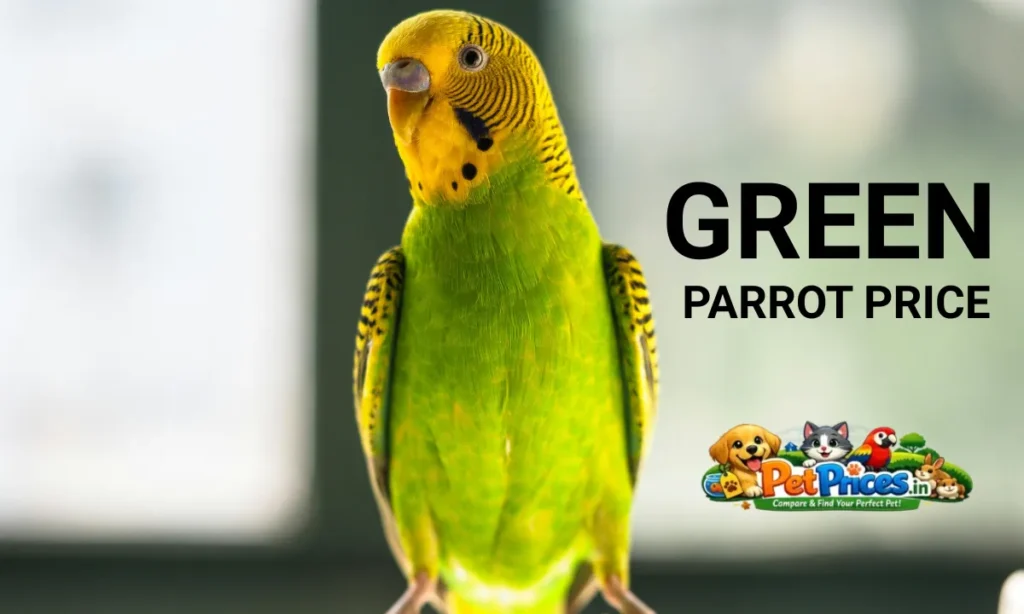
Green Parrot is the name most Indians use for the rose-ringed parakeet, more formally called the Indian Ringneck Parrot the bright green, long-tailed bird you’ll spot in almost every city park and often hear being sold at local bird markets. Before looking at prices, though, there’s something every buyer needs to know upfront: this particular green parrot is a native Indian bird, and that changes the buying picture significantly compared to an imported exotic species.
About the Green Parrot?
The green parrot commonly sold in India is the rose-ringed parakeet (Psittacula krameri), a medium-sized parrot native to the Indian subcontinent and parts of Africa, easily recognised by its bright green body, red curved beak, and long pointed tail. Mature males develop a distinctive rose-pink and black ring around the neck, which is how the bird gets both its common and scientific names, while females and young birds lack this ring. Green parrots are highly social, intelligent, and capable of mimicking human speech with training, which is exactly why they’ve been popular as pets in India for generations despite their wild origins. They typically live 25 to 30 years in captivity, grow to around 16 inches including the tail, and are known for being noisy, active, and demanding of daily interaction. Because this bird breeds so successfully across Indian cities, it’s often assumed to be as freely tradeable as any imported pet bird but its native status places it under a different legal category entirely, which is covered in detail further below.
Green Parrot Price in India: Quick Overview
| Category | Price Range (₹) |
|---|---|
| Local Market Green Parrot (young, hand-raised) | ₹2,000 – ₹5,000 |
| Trained / Talking Green Parrot | ₹5,000 – ₹15,000 |
| Adult Green Parrot | ₹1,500 – ₹4,000 |
| Rare Color Mutation (blue, lutino, albino) | ₹15,000 – ₹60,000+ |
| Breeding Pair | ₹4,000 – ₹12,000 |
The standard wild-green coloured bird remains the most affordable option, while mutated colours which only occur in captive-bred lines and never in wild populations command a considerably higher price due to how selectively they need to be bred.
Green Parrot Price by Color Mutation
| Mutation Type | Description | Price Range (₹) |
|---|---|---|
| Standard Green | Natural wild-type colouring, most commonly available | ₹1,500 – ₹5,000 |
| Blue | Body colour replaced with soft blue tones | ₹15,000 – ₹35,000 |
| Lutino | Yellow-white body with red eyes | ₹18,000 – ₹40,000 |
| Turquoise | Pale blue-green shade, in between standard and blue | ₹20,000 – ₹45,000 |
| Albino | Pure white with red eyes, rarest mutation | ₹35,000 – ₹70,000+ |
| Cinnamon / Pied combinations | Rare patchy or warm-toned combination mutations | ₹30,000 – ₹60,000+ |
Colour-mutated green parrots are exclusively the product of captive breeding programmes, since these colours essentially never appear in wild populations, which is part of why reputable sellers of mutated birds usually also hold proper breeding documentation.
Green Parrot Price by Age
| Age Group | Details | Price Range (₹) |
|---|---|---|
| Hand-fed Chick (6–10 weeks) | Still being weaned, bonds most easily with new owner | ₹3,000 – ₹6,000 |
| Young Bird (3–8 months) | Independent eater, easiest age to begin training | ₹2,500 – ₹5,000 |
| Adult (1–3 years) | Fully coloured with visible neck ring in males | ₹1,500 – ₹4,000 |
| Trained Talking Adult | Already speaking words or phrases | ₹6,000 – ₹15,000 |
Males only develop their signature ring around 2 to 3 years of age, so a young bird’s gender and full adult colouring often can’t be confirmed with certainty until it matures.
Green Parrot Price by City in India
| City | Approx. Price Range (₹) |
|---|---|
| Delhi (Ghazipur Bird Market) | ₹1,500 – ₹6,000 |
| Mumbai | ₹2,000 – ₹7,000 |
| Kolkata (Galiff Street Market) | ₹1,200 – ₹5,000 |
| Bangalore | ₹2,200 – ₹6,500 |
| Chennai | ₹1,800 – ₹5,500 |
| Hyderabad | ₹1,800 – ₹5,500 |
| Smaller towns / local markets | ₹800 – ₹3,000 |
Delhi’s Ghazipur and Kolkata’s Galiff Street remain the largest wholesale bird markets for green parrots in the country, which is also where enforcement of trading restrictions tends to be most actively discussed among buyers and sellers alike.
Factors That Affect Green Parrot Price in India
Colour mutation is by far the biggest price driver, since a plain green bird and a rare albino of the same species can differ in price by ten times or more, purely because mutated colours require dedicated, selective captive breeding. Age matters too young, hand-fed chicks that bond quickly with a new owner cost more than adult birds picked up from open markets, though a trained adult that already talks can command a premium of its own. Training and vocabulary size significantly raise a bird’s value, since teaching a parrot to mimic words takes considerable time and patience from a seller. Documentation is an increasingly important factor as well: birds sold with proof of captive breeding, such as ring identification or breeder paperwork, are priced higher than undocumented birds sold without any proof of legal origin, given the legal sensitivities around this particular species. Finally, city and market access play a role, with metro wholesale markets generally offering lower base prices than birds resold through pet shops with added margins.
Additional Costs of Owning a Green Parrot
A green parrot needs a genuinely spacious cage given its long tail and active nature, which typically costs ₹2,000 to ₹5,000 for a suitable size, along with perches and chew toys adding another ₹300 to ₹1,000. A good seed and pellet mix formulated for parakeets runs around ₹400 to ₹800 a month, with fresh fruits and vegetables adding roughly ₹200 to ₹500 monthly. Calcium blocks and vitamin supplements cost about ₹150 to ₹300 a month, and an annual vet check-up typically runs ₹500 to ₹2,000. Altogether, a realistic first-year budget including the bird itself commonly falls between ₹8,000 and ₹20,000, excluding the higher-priced mutated colour varieties.
Where to Buy a Green Parrot in India
Local bird markets remain the most common source for green parrots, offering the lowest prices and widest visible selection, though the health and legal origin of birds sold this way is frequently uncertain. Registered aviculturists and licensed breeders who specialise in captive-bred colour mutations are a considerably safer route, since these sellers typically operate with proper documentation and can prove their birds were bred in captivity rather than caught from the wild. Online pet classifieds and social media bird-keeping groups are also widely used, though verifying a seller’s legitimacy and the bird’s legal status is essential before any payment changes hands. Given the legal sensitivities discussed below, buying only from a source that can show captive-breeding proof is the safest approach, regardless of which channel you use.
How to Identify a Healthy Green Parrot
A healthy green parrot should have bright, alert eyes with no discharge, and feathers that lie smooth and glossy rather than fluffed up or patchy. Check that the nostrils are clean and dry, and listen for silent, even breathing with no clicking or wheezing sound. The bird should be active and responsive to movement and sound around it, gripping the perch firmly with both feet, and its droppings should be firm rather than watery or unusually discoloured. A parrot that sits puffed up, closes its eyes frequently during the day, or shows little interest in its surroundings may be unwell, and it’s worth asking to see the bird eating on its own before finalising any purchase.
Legal Aspects of Buying a Green Parrot in India

This is the single most important section for any prospective buyer. The rose-ringed parakeet, unlike most other pet birds sold in India, is a species native to the country and is listed under Schedule IV of the Wildlife Protection Act, 1972. This means capturing, keeping, buying, or selling wild rose-ringed parakeets without appropriate government authorisation is illegal, and this restriction applies specifically to the wild-type green colouring, since it’s the colouring found in nature. In practice, informal local markets do continue to sell these birds, and enforcement varies significantly by location, but this does carry genuine legal risk for buyers as well as sellers. Captive-bred colour mutations, such as blue, lutino, or albino birds, are generally viewed differently since these colours cannot occur in wild populations and are the product of documented aviculture programmes buying from a breeder who can demonstrate proper captive-breeding records is the more legally sound route. If you’re set on owning this species, it’s worth speaking with a wildlife law-aware avian vet or an established registered breeder before purchasing, rather than relying solely on what a local market seller tells you.
Frequently Asked Questions
Is it legal to keep a green parrot as a pet in India?
The standard wild-green rose-ringed parakeet is a protected native species under the Wildlife Protection Act, so keeping a wild-caught bird without authorisation is illegal, though captive-bred colour mutations from documented breeders are generally treated differently.
Why do some green parrots cost far more than others?
Colour mutation is the biggest factor standard green birds are common and inexpensive, while blue, lutino, or albino mutations require dedicated captive breeding and cost significantly more.
Can green parrots learn to talk?
Yes, Indian Ringnecks are known for their strong mimicking ability and can learn words and short phrases with consistent training, usually starting from a young age.
How long do green parrots live?
With good care, they commonly live 25 to 30 years, making them a genuinely long-term commitment.
Are male and female green parrots priced differently?
Not significantly pricing is driven far more by colour, age, and training than by gender.
Final Thoughts
A standard green parrot in India typically costs between ₹1,500 and ₹5,000, while rare captive-bred colour mutations can run into tens of thousands of rupees. Unlike most other pet birds covered in price guides like this one, though, the legal status of this particular species is genuinely important to understand before buying its native status under Indian wildlife law means the safest and most responsible purchase is one backed by proper captive-breeding documentation, not simply the lowest price at a local market.
You must know: Cockatiel Bird Price